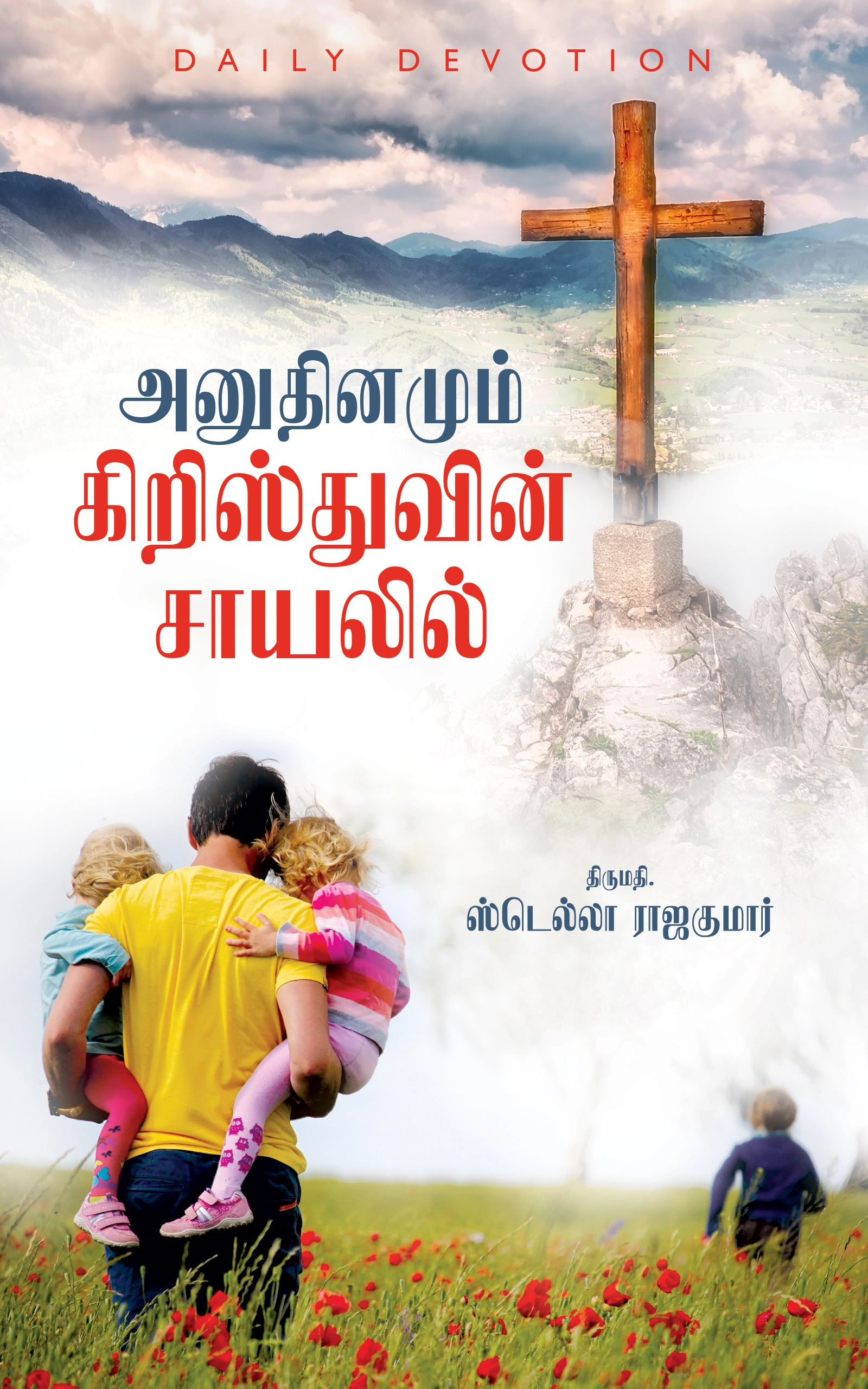
Daily in Christ's Image is a full-year daily devotional by Stella Rajakumar, published by Kirubalayam Ministry, covering every day from January through December. Each entry pairs a Scripture passage with a brief exposition and a practical challenge, all built around a single governing conviction: that God has predestined every believer to be conformed to the image of His Son (Romans 8:29).
Written originally in Tamil for individual, family, and small-group use, the devotional moves through the full range of Christian character and practice across a calendar year - personal and family prayer, parenting, generosity, forgiveness, holiness, hope, and gratitude - making it one of the most comprehensive devotional resources available in the Tamil Christian tradition. It is relevant to any Christian reader who wants a daily rhythm of Scripture, self-examination, and practical application sustained across a full year.
On This Page
About This Book
Published by Kirubalayam Ministry in 2023, Daily in Christ's Image is an approximately 460-page, full-year daily devotional written by Stella Rajakumar, M.Sc. (Psy), M.Ed. It was written to address a gap Rajakumar observed in Tamil Christian devotional literature: resources that engage the daily life challenges of Tamil-speaking believers in their own cultural idiom, covering everything from personal prayer to marriage, parenting, youth, and old age.
Each of the devotional's roughly 365 entries follows a consistent pattern - a date, a topic, a key Scripture verse, and several paragraphs of exposition and application, closing with a scriptural challenge. The book is organised thematically by month rather than randomly, so that a reader who works through the year in order moves through a deliberate curriculum of Christian formation.
Central Message
The devotional's governing text is Romans 8:29 - "He predestined us to be conformed to the image of His Son." Rajakumar presents the entire book as an instrument of that conformation, addressing not only the reader's spirit but their marriage, parenting, finances, speech, and character, all through the lens of becoming more like Christ. A secondary current running through the book is community: alongside personal devotion, entries repeatedly address family prayer, church worship, and care for missionaries, positioning the book as a resource for family and church formation together, not merely private reading.
Main Themes
Conformation to the Image of Christ
Every entry, whatever its specific topic, serves the book's central aim of Christlikeness (Romans 8:29).
The Living Power of God's Word
Each entry is built on a scripture meant to be carried through the day as guidance, comfort, and promise (Hebrews 4:12).
Daily Self-Examination
Psalm 139:23-24 provides the pattern for healthy, non-morbid daily self-examination that the book consistently commends.
Prayer as Daily Conversation with God
The devotional distinguishes reading (receiving from God) and prayer (speaking to God) as complementary daily necessities.
Holiness as Pressing Toward Perfection
Drawing on Philippians 3:12-14, holiness is presented as a direction continually pursued, not a standard already attained.
The Seasons of Life
The devotional covers personal, family, youth, middle-life, and elderly devotion within a single year-long structure.
Joy, Gratitude, and Contentment
These are presented as spiritual disciplines to be cultivated daily, not feelings to be passively awaited (Philippians 4:4).
Chapter-by-Chapter Summary and Analysis
The devotional contains approximately 365 individual daily entries. The analysis below covers representative entries organised by month, as structured in the original book.
January - Foundations
The year opens with a call to make specific resolutions for character growth in Christ (1 Peter 1:15, Romans 12:1), alongside self-examination (Psalm 139:23-24) and daily surrender. Early entries establish personal prayer as the primary means of growing in holiness (Matthew 6:6), followed by family prayer, the model family, and raising children in the fear of the Lord (Proverbs 22:6). Later January entries address example parents, devoted youth, fruitful elderly life, prayer, meditation, generosity, and mercy - establishing the key spiritual disciplines for the rest of the year.
February - Grace, Faith, and Relational Virtues
God's grace is presented as enabling power, not merely pardon (2 Corinthians 12:9). Faith is defined as confident expectation, built daily through the word (Hebrews 11:1, Romans 10:17). Further entries address kindness (Ephesians 4:32) and patience (Ephesians 4:2) as expressions of the fruit of the Spirit.
March - Discipline, Obedience, and Integrity
Discipline is presented as producing a harvest of righteousness (Hebrews 12:11). Obedience is valued above mere religious performance (1 Samuel 15:22), and integrity is grounded in the Lord's delight in trustworthy people (Proverbs 12:22).
April - Servanthood and Humility
Greatness is redefined as servanthood (Matthew 20:26), and humility is described not as thinking less of oneself but thinking of oneself less, following the promise that God gives grace to the humble (James 4:6).
May - Worship and Gratitude
Worship is presented as a lifestyle rather than an event, grounded in worship "in spirit and truth" (John 4:23). Gratitude is framed as the posture of a heart that understands grace, giving thanks in all circumstances (1 Thessalonians 5:18).
June - Justice and Generous Giving
Entries call readers to defend the oppressed and plead for the widow (Isaiah 1:17), and to give freely and generously to God's work and the poor, trusting that the generous person will never lack (Luke 6:38).
July - Courage and Steadfastness
Drawing on Joshua 1:9, readers are called to be strong and courageous because God goes with them. Steadfastness is grounded in 1 Corinthians 15:58 - standing firm and letting nothing move you - describing an unshakeable commitment to Christ through all seasons.
August - Holiness and Purity
Hebrews 12:14 anchors the teaching that without holiness no one will see the Lord, made possible because God's Spirit lives in believers. Purity is addressed through Matthew 5:8, calling readers to guard their thoughts, eyes, ears, and relationships.
September - Perseverance and Trust
Perseverance is framed through Hebrews 12:1-2 - running with endurance while fixing eyes on Jesus. Trust draws on Proverbs 3:5-6, calling readers to trust with all their heart and acknowledge God in all their ways.
October - Hope and Peace
Isaiah 40:31 presents hope in the Lord as the source of renewed strength - confident expectation rather than wishful thinking. Peace is grounded in John 14:27, distinguishing the peace Christ gives from worldly peace as His presence in the midst of trouble.
November - Forgiveness and Love
Forgiveness is presented as a choice rather than a feeling, following Colossians 3:13's call to forgive as the Lord forgave. Love is grounded in 1 Corinthians 13:4, expressed within the family through small daily acts of service and choice.
December - Joy and Expectation
Joy is distinguished from happiness in that it depends on God rather than circumstances (Philippians 4:4). The devotional closes on December 31 with Lamentations 3:22-23 - God's mercies are new every morning - calling readers to enter the new year with faith, surrender, and expectation.
Key Bible Passages
- He predestined us to be conformed to the image of His Son - the book's governing purpose.Romans 8:29
- The word of God is living and active - the basis for daily Scripture engagement.Hebrews 4:12
- Search me, O God, and know my heart - the model for daily self-examination.Psalm 139:23-24
- As He who called you is holy, so be holy in all you do - the January 1 foundation.1 Peter 1:15
- When you pray, go into your room, close the door, and pray - personal prayer.Matthew 6:6
- If two of you on earth agree about anything they ask for, it will be done - family prayer.Matthew 18:19
- Rejoice in the Lord always - the foundation of the joy entries.Philippians 4:4
- His mercies are new every morning; great is Your faithfulness - the year-end entry.Lamentations 3:22-23
- Start children off on the way they should go - the parenting entries.Proverbs 22:6
- Those who hope in the Lord will renew their strength - the hope entries.Isaiah 40:31
Key Christian Principles
- Formation over information. A devotional read once is an inspiration; read daily for a year, it becomes formation. The value of the book lies in its cumulative, daily discipline rather than any single entry.
- Family integration. The devotional weaves family prayer, parenting, youth, and elderly entries into a single year, making it suited to multigenerational household use rather than individual reading alone.
- Morning-to-evening rhythm. The pattern of morning Scripture, daily self-examination, and evening confession reflects one of the most time-tested disciplines in Christian spiritual formation.
Practical Application
For personal use:
- Use the devotional as a daily anchor - read the entry each morning, carry the scripture through the day, and return in the evening for self-examination.
- Use January's foundational entries to establish habits - personal prayer, family devotion, and weekly resolutions - that sustain the rest of the year.
- Keep a journal alongside the devotional, recording how each day's scripture addresses your actual life situation.
- Follow the book's year-end pattern on December 31: a gratitude list, a confession list, and three specific expectations for the coming year.
For church and family use:
- Distribute the devotional to families in the congregation as a shared discipleship resource.
- Form a congregation-wide accountability group that uses the devotional together and shares brief weekly reflections.
- Use the book's thematic months - January's foundations, August's holiness, November's forgiveness - as the basis for a sermon series.
- Give the devotional as a gift to new believers or newly married couples as part of their Christian formation.
Key Takeaways
- Daily in Christ's Image is a comprehensive, full-year devotional grounded in Romans 8:29 - the conviction that every believer is predestined to be conformed to the image of Christ.
- It covers the full range of Christian life - personal prayer, family devotion, generosity, forgiveness, justice, holiness, and hope - serving both individual and family use.
- It provides a full-year curriculum in Christian discipleship, accessible to the Tamil Christian layperson while remaining rich enough to sustain genuine spiritual growth.
Frequently Asked Questions
Who wrote Daily in Christ's Image?
The book was written by Stella Rajakumar, M.Sc. (Psy), M.Ed., and published by Kirubalayam Ministry in 2023.
What is the central message of the book?
The book's governing conviction, drawn from Romans 8:29, is that God has predestined every believer to be conformed to the image of His Son - and the devotional is structured to be an instrument of that daily conformation.
Who is this devotional written for?
It is designed for individual, family, and small-group use, with entries addressing personal prayer, marriage, parenting, youth, and old age, making it suitable for multigenerational household devotion.
How is the book organised?
It contains approximately 365 daily entries organised thematically by month - from the foundational disciplines of January through the joy and expectation of December - rather than in random order.
Is this summary a replacement for reading the original book?
No. This page is a study aid covering the book's structure, themes, and representative entries. Readers are encouraged to read the complete original devotional for its full daily content across all twelve months.
Get the Original Book
This page is a summary and study aid. For the complete year-round devotional, read the original book by Stella Rajakumar.
Related Kirubalayam Publications
This summary and chapter-by-chapter analysis was prepared with AI assistance from the published work and is provided as a study aid. Readers are encouraged to refer to the original book for the complete treatment of the subject.