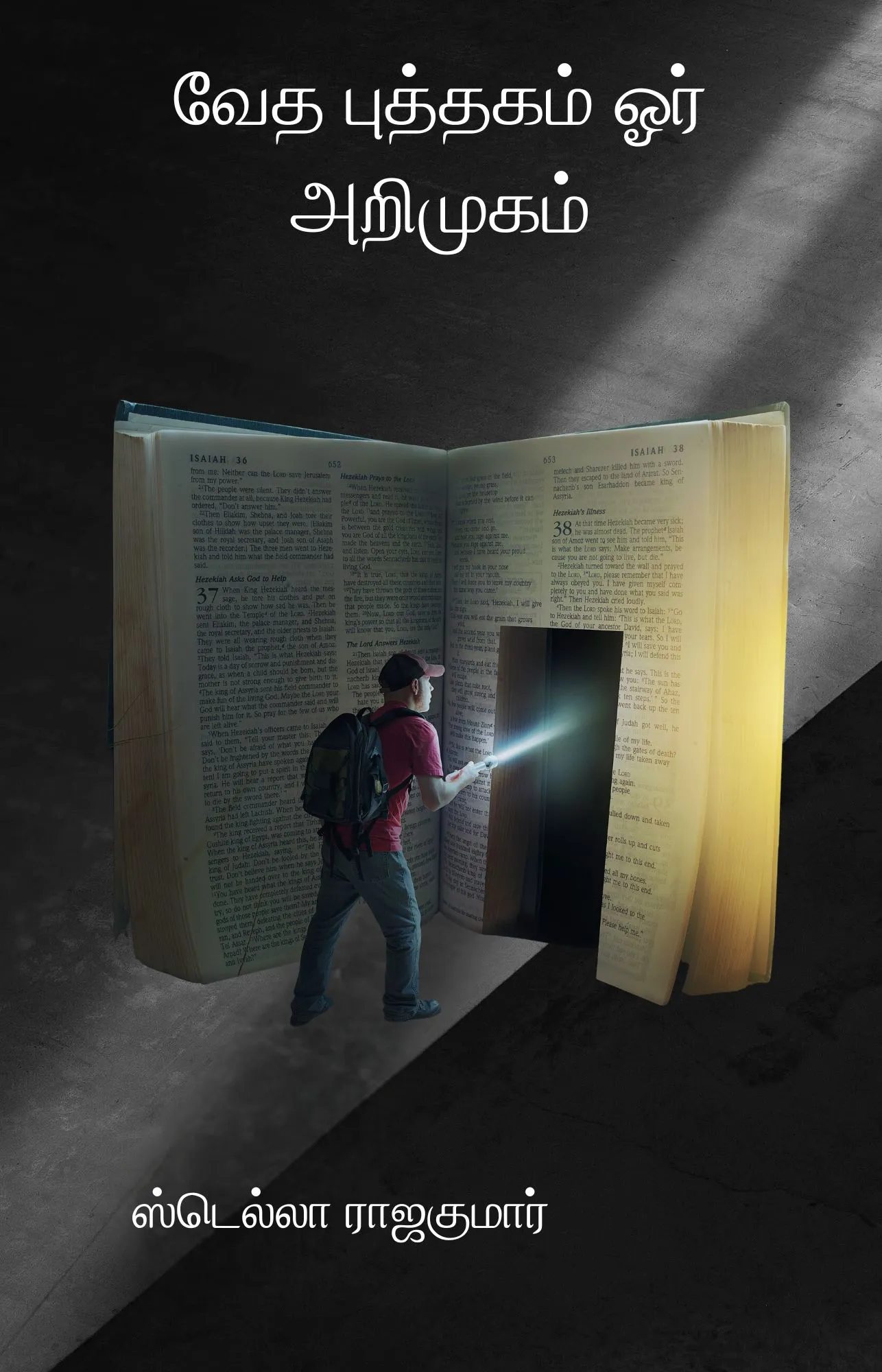
The Bible: An Introduction is a comprehensive Tamil-language survey of all 66 books of the Bible by Stella Rajakumar, giving for every book a chapter distribution, content summary, key passage, and key verse. It moves from the Preface and a Christ-centred "Two Adams" framework through the Old and New Testaments to a set of practical reference tables.
Published by Kirubalayam Ministry, the book is grounded in the conviction that all 66 books were written by the Holy Spirit and can only be rightly understood through dependence on the Spirit rather than intellectual effort alone. It is relevant to new believers, Sunday school teachers, home Bible study leaders, and any Christian reader who wants a reliable overview of the whole Bible in one volume.
Translated from the original Tamil by Sam Rajakumar.
On This Page
About This Book
Published by Kirubalayam Ministry in 2024, The Bible: An Introduction was written by Stella Rajakumar, M.Sc. (Psy), M.Ed., addressing a gap in Tamil Christian literature: systematic resources introducing ordinary readers to all 66 books of the Bible in one accessible volume. The book's theological framework reflects the Reformed evangelical tradition, affirming the five Solas of the Reformation.
The book opens with a Preface and Introduction establishing the divine inspiration of Scripture, followed by a pivotal "Two Adams" section bridging the Old and New Testaments. Part One surveys all 39 Old Testament books by section - Law, Historical Books, Wisdom and Poetry, Major Prophets, and Minor Prophets. Part Two covers all 27 New Testament books - the Gospels, Acts, Paul's epistles, the General Epistles, and Revelation - followed by five practical reference sections.
Central Message
The book's foundational conviction, stated in the Preface, is that "the Holy Bible was written by the Holy Spirit." All 66 books are presented as equally inspired and authoritative, grounded in 2 Timothy 3:16-17. Rajakumar insists that Scripture "cannot be understood through our brain's intellect alone - it can only be understood through the Holy Spirit," and that Scripture must be read slowly and meditatively until the specific word for that day arrives.
Main Themes
Divine Inspiration and Authority of Scripture
All 66 books are presented as equally inspired and authoritative, from Genesis through Revelation, grounded in 2 Timothy 3:16-17.
The Redemptive Arc
The "Two Adams" framework traces Creation, Fall, Redemption, and Restoration through every section of the Bible.
Jesus Christ as the Fulfilment of All Scripture
A table of 35 messianic prophecies and their New Testament fulfilments demonstrates Christ as the interpretive key to the Old Testament.
Obedience and the Covenant
Blessing for obedience and curse for disobedience runs through the historical books, especially Deuteronomy, Joshua, and Judges.
The Holy Spirit as Author and Illuminator
The Spirit is both the original author of Scripture and the necessary guide for understanding it, positioning the reader in prayerful dependence.
Holiness and Christlikeness as the Goal
God's word keeps believers holy and transforms them into the image of the Son (Romans 8:29), connecting to Daily in Christ's Image.
Chapter-by-Chapter Summary and Analysis
The book is structured as a survey rather than a conventional narrative. The analysis below follows its own sections.
Preface, Introduction, and The Two Adams
The Preface states that Scripture helps those burdened with guilt receive God's righteousness, keeps believers holy, sustains them through trials, and shows the path to heaven. The Introduction teaches that the Bible must be read slowly and meditatively, depending on the Holy Spirit rather than intellectual effort. "The Two Adams" then bridges the Testaments: Adam's disobedience brought sin and curse; Christ's obedience restored the relationship with God and broke every curse - introducing the five Reformation solas as the book's theological framework.
The Law and the Historical Books
The five books of the Torah are surveyed with chapter distribution, summary, key passage, and key verse - from Genesis (creation and Abraham's calling) through Deuteronomy (the blessings of obedience and curses of disobedience). The twelve historical books, Joshua through Esther, are presented as the unfolding story of God's covenant with Israel, in which obedience brings blessing and disobedience brings discipline, culminating in the exiles and God's faithful restoration.
Wisdom and Poetry, and the Major and Minor Prophets
The five wisdom books engage the full range of human emotional and spiritual experience, with the Psalms treated most extensively - noting their author groups and highlighting psalms of confession, praise, protection, and the Law's authority. The five major prophets and all twelve minor prophets are each treated individually, with Isaiah's Suffering Servant passage (ch. 53) given particular prominence as a pre-written account of Christ's crucifixion.
The Gospels, Acts, and Paul's Thirteen Epistles
The four Gospels are presented as complementary portraits of Jesus - King in Matthew, Servant in Mark, Saviour in Luke, the eternal Word in John. Acts traces the Spirit-empowered spread of the Gospel from Jerusalem to Rome. Paul's thirteen epistles are treated individually, including the four Prison Epistles, moving from justification (Romans) through sanctification (Galatians, Ephesians) to eschatology (Thessalonians) and pastoral order (Timothy, Titus).
The General Epistles and Revelation
Hebrews, James, 1-2 Peter, 1-3 John, and Jude address the full range of challenges facing the early church - persecution, false teaching, and the need for assurance. Revelation closes the survey not as a source of fear but of triumphant hope: Christ's letters to the seven churches, the Throne and the Lamb, and the New Jerusalem descending - God dwelling with His people forever.
Reference Sections
Five reference sections enhance the book's value as a teaching and apologetics resource: a table of 35 messianic prophecies and their New Testament fulfilments; a Biblical timeline from Creation to Revelation; a table of all 18 prophets with their audience, era, and kings; Psalm highlights; and a selection of key promise verses from Proverbs.
Key Bible Passages
- All Scripture is God-breathed and useful for teaching, rebuking, correcting, and training in righteousness - the book's foundational verse.2 Timothy 3:16-17
- The words I have spoken to you are full of the Spirit and life - supporting Spirit-dependent Bible reading.John 6:63
- The word of God is alive and active, sharper than any double-edged sword.Hebrews 4:12
- Through the disobedience of the one man the many were made sinners; through the obedience of the one man the many will be made righteous.Romans 5:19
- I stand at the door and knock - the personal invitation closing the Two Adams section.Revelation 3:20
- He was pierced for our transgressions - the Suffering Servant prophecy, the most explicit messianic prophecy in the Old Testament.Isaiah 53:5
- Act justly, love mercy, and walk humbly with your God - the Old Testament's ethical summary.Micah 6:8
- God's dwelling place is now among the people - the Bible's final promise.Revelation 21:3-4
Key Christian Principles
- Unity through Christ. The Two Adams framework - fall through the first Adam, restoration through the second - unlocks the coherence of all 66 books as a single story.
- Spirit-dependent reading. The Bible's power is unlocked not by intellectual effort alone but by the Holy Spirit working in and through a reader who comes in dependence and obedience.
- Equal weight for every book. Sola Scriptura is demonstrated, not merely stated - the minor prophets and general epistles receive the same careful attention as Genesis and the Gospels.
Practical Application
For personal use:
- Use this book as a reading companion alongside a systematic Bible reading plan - reading each book's summary before starting that book of the Bible.
- Never rush through Scripture. Read each day's passage until the word for that specific day arrives - a promise, a warning, or a directive - then carry it through the day.
- Memorise the key verses provided for each major book as a strong starting selection for Scripture memory.
- Use the messianic prophecy table in personal evangelism as an accessible evidential argument for the divine inspiration of Scripture.
For church use:
- Use this book as the textbook for a church-wide Bible survey programme, covering one book per week.
- Equip Sunday school teachers with this book as their reference before they begin teaching a book of the Bible.
- Use the Biblical timeline as a visual teaching aid for youth groups and new believer classes.
- Train lay preachers and home group leaders to use the key passage and key verse structure as their framework for preparing short Bible talks.
Key Takeaways
- The Bible: An Introduction is a comprehensive Tamil-language survey of all 66 books of the Bible, giving chapter distribution, summary, key passage, and key verse for each.
- Its Christ-centred "Two Adams" framework, five Reformation solas, and table of 35 messianic prophecies give it particular value as both a devotional and an apologetics resource.
- It serves simultaneously as a personal devotional companion, a reference tool for teachers and group leaders, and a resource for demonstrating the divine inspiration of Scripture.
Frequently Asked Questions
Who wrote The Bible: An Introduction?
The book was written by Stella Rajakumar, M.Sc. (Psy), M.Ed., and published by Kirubalayam Ministry in 2024. It was translated from the original Tamil by Sam Rajakumar.
What is the central message of the book?
All 66 books of the Bible were written by the Holy Spirit and are equally inspired and authoritative, and Scripture can only be rightly understood through dependence on the Holy Spirit rather than intellectual effort alone.
Does the book cover the whole Bible, or select books?
It covers all 66 books - all 39 Old Testament books and all 27 New Testament books - each with its own chapter distribution, summary, key passage, and key verse.
What is the "Two Adams" section?
It is a theologically pivotal section bridging the Old and New Testaments, showing how Adam's disobedience brought sin and curse while Christ's obedience restored humanity's relationship with God - establishing the book's interpretive framework for the whole Bible.
Is this summary a replacement for reading the original book?
No. This page is a study aid covering the book's structure and major sections. Readers are encouraged to read the complete original book for its full survey of all 66 books, including the detailed reference tables.
Get the Original Book
This page is a summary and study aid. For the complete survey of all 66 books with full reference tables, read the original book by Stella Rajakumar.
Related Kirubalayam Publications
This summary and chapter-by-chapter analysis was prepared with AI assistance from the published work and is provided as a study aid. Readers are encouraged to refer to the original book for the complete treatment of the subject.